.png)
Legal Paradox®

On September 2, 2020, I published an article titled: "Lawyers: Chronicle of a Death Foretold."
I wrote it from the trenches. For years, I had watched the Mexican legal profession view digital transformation as if it were a phenomenon happening to others. To banks. To retailers. To startups. But not tot hem.
I was wrong about one thing: I was too conservative with the timeline.
I said that legal disruptive innovation would arriveand eliminate traditional incumbents. I didn't calculate that it would arrive so quickly, nor that I would be the one to build that disruption myself.
In that article, I warned that more than 778,125 lawyers with a professional license were building their future on sand. I warned that the model of land, capital, and labor as factors of legal production was obsolete—a dead man walking. I warned that emerging technologies would position themselves as a new factor of production capable of providing legal services at a speed impossible for any human.
No one believed me. Not even when Lexlatin.com picked up the story.
Today, I’m not here to say "I told you so"—though technically, I did.
Rather, I’m here to show you the numbers behind that foretold death.
Because in 2026, after 1,437 days of building in public, Legal Paradox® became the world's first AI-native law firm. And it’s in Mexico, not Silicon Valley. Not London. Not Singapore.
In Mexico.
Matt Shumer, founder of OthersideAI, published an analysis that is already circulating widely: "Something Big Is Happening." His central thesis is that we are in the equivalent of February 2020 of the pandemic—most people don't see it yet, but the tide is already at chest level. Shumer documented how AI models went in months from writing lines of code to building complete applications, testing them, fixing them, and delivering them ready for use. Without human intervention in the process.
What Shumer describes for the software world, we implemented for the legal world months ago. With our own architecture, real clients, and numbers that no one in Mexico—or Latin America—has published before. Until today.
Zack Shapiro, a practicing lawyer at a two-person boutique firm in the United States, recently published "The Claude-Native Law Firm"—a technical manual on how he uses Claude in real legal production. His conclusion is staggering: a lawyer properly configured with Claude outperforms teams of associates from firms with hundreds of lawyers interms of speed, depth, and cost.
Shapiro describes the state of the art.
We have surpassed it.
And the difference is not one of degree—it is one of architecture.
Being AI-native does not mean using Claude as a sophisticated search engine. It doesn't mean asking it to summarize a contract or draft an email. Any lawyer with a $20 monthly subscription can do that. That is using AI as a tool. Useful, but not transformative.
A note on terminology: Zack Shapiro coined "Claude Code-native" to describe a legal practice built entirely around Claude Code as its operational core. We adopt the broader category: AI-native. The distinction matters. "AI-native" describes a business model where artificial intelligence is the central factor of production — not a tool bolted onto a traditional firm. "Claude Code" describes our current architectural choice — the specific infrastructure that delivers 0% hallucinations on regulated deliverables. We are AI-native. Today, that means Claude Code.
Tomorrow, it means whatever architecture maintains that standard. The model is infrastructure. The judgment is ours. Legal Paradox® predates Claude Code. What changed in 2026 was not an update or an add-on — it was a ground-up reconstruction of every production process, economic model, and governance framework around this architecture. No legacy billing structure. No associates executing tasks the pipeline now handles. No prior version coexisting with the current one. In software terms, the closest analogy is a company that existed before AWS and rebuilt entirely for the cloud — not cloud-assisted, but cloud-native in architecture and incentives. That is the standard we hold ourselves to.
A AI-native firm means something radically different: artificial intelligence is not a tool used by lawyers—it is the connective tissue of the entire operation. Every document, every regulatory analysis, every authorization file, and every contract is born, verified, audited, and delivered within an architecture of agents designed specifically for high-precision legal production.
It is not a chat interface. It is a pipeline.
There are two layers to how we operate. The distinction matters for any regulated client, and most legaltech narratives collapse them into one.
Layer one — how we build Juridicon. Development, infrastructure, and new capabilities are written using Claude Code on Anthropic's commercial API under Zero Data Retention terms. No prompt, no response, and no artifact from the build workflow is stored on Anthropic's servers beyond the active session. No data from how we build the platform is used to train future models.
Layer two — how client matters actually run. Every client engagement executes on our own AWS infrastructure. Region-controlled. Encrypted end-to-end with KMS keys that Legal Paradox® controls. Hardware-isolated on Nitro System. The AI model is invoked by API under Zero Data Retention terms. Client documents, regulatory analysis, deliverables, and audit trails reside exclusively in that AWS environment. They never pass through the development workflow, and they never persist on any AI provider's servers.
Shapiro uses claude.ai — the consumer interface. We do not. The consumer interface has different data retention defaults and is not acceptable under Mexican attorney-client privilege requirements. In regulatory law, where professional secrecy has no exceptions, this is not a technical detail. It is the minimum requirement to exist.
To be precise about what IS stored: all client data — documents, analysis, deliverables, audit trails — resides exclusively in Legal Paradox®'s own AWS infrastructure, under KMS encryption with keys controlled by LP, Nitro System hardware isolation, and LP's own data governance framework. The distinction matters: we chose not to outsource data custody to any AI provider. The models reason on our data during the session. When the session ends, the models retain nothing. The data lives in our vault — not theirs.
In regulatory law, where professional secrecy has no exceptions, this difference is not a technical detail. It is the minimum requirement to exist.
The practical distinction is as follows. When a traditional lawyer "uses AI," they take an output and review it manually. The bottleneck remains human—and remains linear. When Legal Paradox® produces a document, an orchestrator breaks down the problem into micro-tasks. Multiple executor agents work in parallel on the verified regulatory framework. A fresh adversarial agent—our devil's advocate—with clean context and no bias, whose only mission in life is to destroy the executor's work, reviews it. Finally, five mandatory human review gates interpret the regulatory framework, pouring in over 20 years of legal experience and making strategic decisions before any line reaches the client's hands.
The result is not a draft that needs correction.
It is a deliverable.
This architecture has a consequence that no legal AI tool has managed to document publicly: 0% hallucinations in final deliverables. Not as a marketing promise—as a verifiable operational metric with a complete audit trail (a step-by-step record of the history of a document or process).
Stanford RegLab presented a benchmark at NeurIPS 2025 that should alarm any firm using AI without architecture: the best legal RAG (Retrieval-Augmented Generation, a method that provides AI with external data to improve accuracy) systems hallucinate between 17% and 33% of the time. One out of every three responses could be incorrect. In regulatory law, that isn’t a margin of error—it’s a ticking bomb.
To be precise about our own claim: our AI hallucinates. Of course it does. Every model does. What we have is an architecture that catches it before it reaches the client — every time. The orchestrator grounds the model on verified regulation. The adversarial agent hunts for errors with clean context. Five mandatory human gates make the final call. The result is not a system that never hallucinates. It is a system where hallucinations never survive to the deliverable. That is what 0% means — and that is a verifiable operational metric, not a marketing promise.
Our architecture does not solve this problem with more prompts. It solves it structurally: the model never responds from its parametric memory. It responds exclusively from the verified regulatory framework, updated and structured as the source of truth. The regulation rules, our interpretation and experience generate the correct path, and the model reasons and learns from it. Lawyers make the decisions that no model can: strategic ones.
That is a true AI-native firm.
Now then — how does this work in real production? Here is the exact architecture.
Most firms that say they use AI have a ChatGPT tab open in their browser.
We have a pipeline.
The difference between the two is the same as the difference between having a calculator and having an accounting system. One helps you with an operation. The other manages a company's entire financial architecture. Claude Code is not the calculator. It is the system.
This is how our architecture works in real production:
Our orchestrator agent receives the complex problem—an authorization file for the CNBV, a master financial services agreement, or a massive update of regulatory documents—and surgically breaks it down into parallel micro-tasks. It does not work in sequence. It works simultaneously. This is only possible because Claude Code can manage multiple executor sub-agents coordinated from a single master instruction.
Each terminal in the process represents a different client project. This is not sequential—it is the exponential scalability of the legal industry, and the first time multitasking pays off.
This is what a legal Audit Trail looks like in 2026:
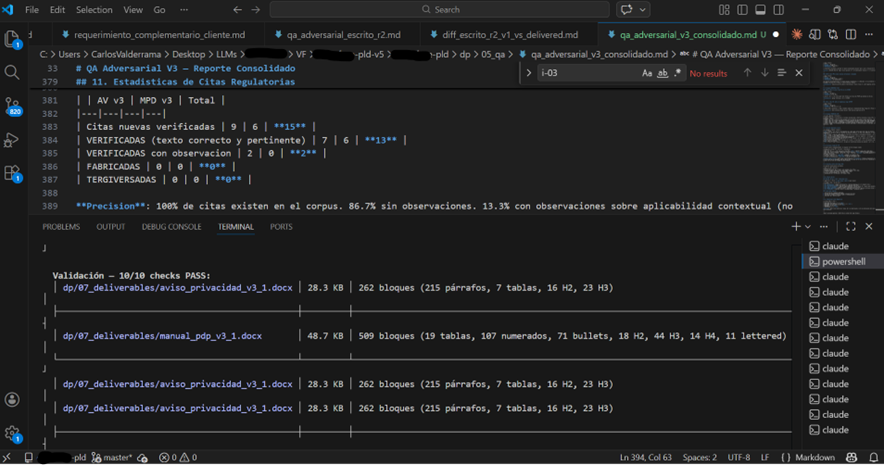
The specialized executor agents work each micro-task against the Legal Paradox® verified regulatory framework—not against the model's parametric memory. This is critical. A language model trained up to a certain date might hallucinate a provision that was modified by a CNBV circular three months ago. Our corpus is updated— and we can prove it. Every Skill and every template is bound to the specific version of the regulation it was validated against: which DOF publication date, which reform, which article text. A monitoring agent scans the Official Gazette every morning. When it detects a reform that affects an active Skill — say, a modification to Article 17 of the LFPIORPI — it automatically invalidates every Skill that cited that article. The pipeline will not use an invalidated Skill until a human re-validates it against the new text. The model doesn't reason on memories. It reasons on regulation we can trace to a specific DOF publication, verified as of today.
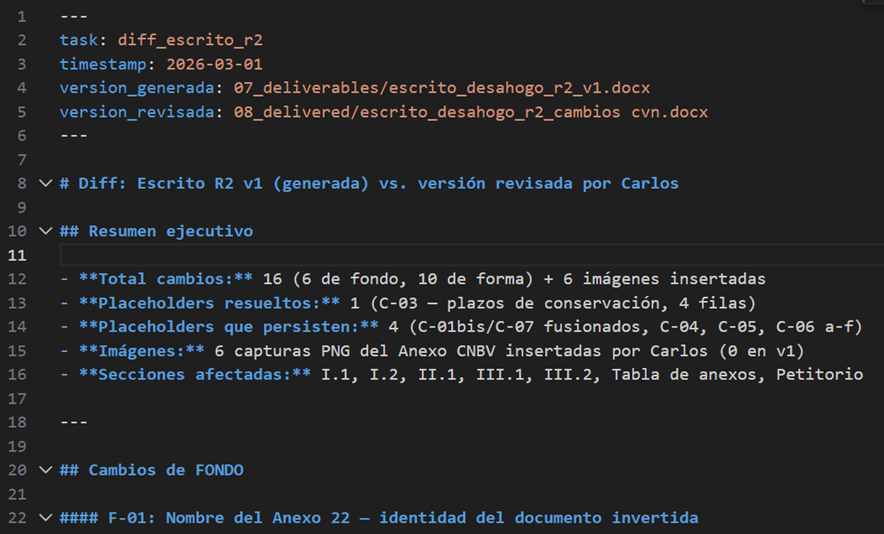
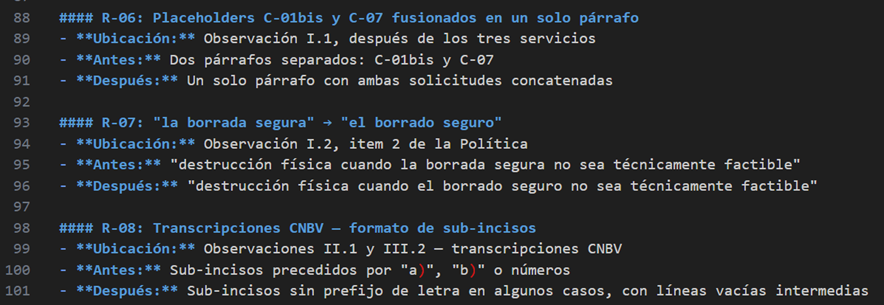
The adversarial agent is the element that sets usapart from any implementation we have seen documented publicly. It is a fresh agent—clean context, zero exposure to the executor's work—whose only mission isto find flaws. Logical inconsistencies. Misquoted citations. Provisions applied out of context. Conflicts between documents in the same file. This agent has no confirmation bias. It doesn't know what answer is expected. It only knows it has to destroy the work someone else prepared. In two production cycles, this agent detected 100 adversarial QA findings. 20 of them were "blockers"—errors that, had they reached the client, would have compromised the entire deliverable.
Those 20 findings are the reason we exist.
In 2024, I described a basic version of this architecture we were building with ChatGPT to a high-ranking CNBV official. His response was immediate and unfiltered: "You're cheating."
I stayed silent for a moment.
And I thought: yes. It might seem that way. But it isn't; it's engineering.
It felt like cheating when, in university, I was the only one who brought my legal codes on a laptop. When "El Notario" (a non plus ultra public notary) a sacred cow of Mexican law, asked a question, I answered in seconds. His response was to fail me and send me to a special remedial exam (extraordinario) to teach me a lesson, insisting I had to bring the physical codes.
Although it was quite a drama and I almost lost my scholarship (I always came from humble beginnings and certainly couldn't afford to study at Mexico's best university without it), that later became part of my meteoric rise in Mexico's top law firms. Everything seemed like cheating. I was always the one who arrived with an advantage the establishment didn't understand. The difference is that today, I’m not the only one with this advantage — every client who trusts our architecture has it too.
In our process, the five human gates are mandatory and have no exceptions. They are not a courtesy review. They are the point where 20+ years of regulatory experience interpret what no model can interpret alone: the regulator's intent, the political context of a provision, and the history of CNBV criteria in analogous cases. Although we feed the model with official documents (oficios) from every process carried out in Mexico via transparency laws, the human still provides the final strategic layer to maximize the odds of authorization in one of Mexico's most regulated segments.
Each gate documents 33 human decisions with a complete chain of reasoning — an audit trail that complies with Mexican Jurisprudence and the best international standards on AI transparency in legal processes.
Inter-document cross-verification is the final element. When an authorization file has 60 interdependent documents and an error is detected in document 7, the system automatically propagates the correction to all related documents. In the traditional model, that propagation requires a lawyer to manually review every document. In our architecture, it happens automatically in real time.
The result of this chain: one week of total "agentic time" to produce a file that previously required 8 lawyers and 8 months to prepare. We now generate legal documents as if they were linesof code. Audited, versioned, and ready for delivery.
This is not an experiment.
It is production with real clients.
The architecture extends beyond legal production. When a prospective client fills out our intake form — name, company, challenge, budget — the system activates before the first meeting. An enrichment agent researches the prospect's background: their LinkedIn profile, their company's funding history, their regulatory universe. A pricing agent calibrates a three-tier proposal against our database of 520+ engagements, adjusting for client capacity, market positioning, and competitive landscape. A presentation agent generates a professional deck. A cover email agent drafts a hyper-personalized message that references the prospect's specific background — not a template, but a letter that demonstrates we already understand their world.
Three human gates review the output before anything reaches the prospect. The partner edits pricing. Reviews the presentation. Approves the final email. The system produces. The human decides.
The AI pipeline generates the complete proposal — market research, three-tier pricing, competitive analysis, personalized cover email, and presentation draft — in under five minutes of processing time. The partner then reviews and refines across three quality gates, each requiring minutes of focused strategic judgment rather than hours of production work. Total time from prospect intake to polished proposal sent: under two hours of elapsed time, of which less than thirty minutes is human work. The traditional equivalent: two to five business days.
But the architecture doesn't end with the deliverable. Each production cycle generates structured feedback signals—what the agent did well, what it needs to improve, and what errors it must not repeat. The system doesn't just produce. It learns.
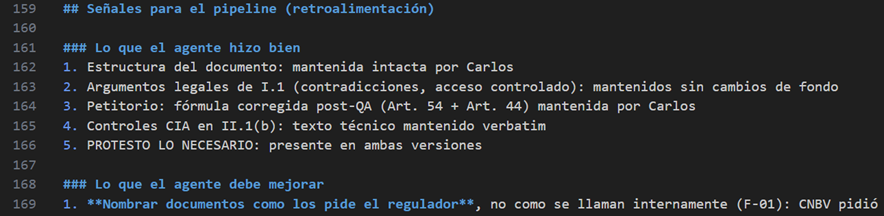
This is not machine learning in the classic technical sense. It is something more valuable and harder to replicate: Scaled Human Judgment. We aren't selling AI — we are selling 520 projects, 20 years of regulatory criteria, and the interpretation of a co-drafter of the Fintech Law, converted into instructions that any instance of the pipeline can invoke without degradation. The value isn't in the model. Anyone can have the model. The value is in what only we know how to tell it. Every project makes the next one more precise—but above all, more uniquely ours.
And here is the element that turns all of this into a truly scalable system: Skills.
Every regulatory analysis framework, every CNBV interpretation criterion, and every structuring pattern we have developed in more than 520+ projects and 20 years of practice is encoded into Skills — structured instruction modules stored in a centralized registry, version-controlled, and validated against the live regulatory corpus before every use. Each Skill has a documented lineage: which engagement created it, which regulations it was validated against, when it was last verified, and what human corrections refined it. When a regulation changes, the monitoring system automatically flags every Skill that cited it — invalidating it until a human re-validates. It's not a prompt someone writes every time. It is the accumulated judgment of a specialist, version-controlled like software, validated like a legal opinion, and available in any instance, at any time, without degradation.
Zack Shapiro documented this for his individual practice: "The knowledge that takes years of mentoring to transmit is now an instruction file that works from the first draft."
We take it one step further: it’s not the knowledge of one lawyer—it is the distilled knowledge of hundreds of Mexican regulatory processes, versioned, audited, and improved with each production cycle.
And here is the element that transforms Skills from a convenience into a compounding moat: every engagement feeds the system back.
When a client matter completes — after all five human gates have approved the deliverables — the pipeline doesn't just archive the work. It analyzes every correction made during the gates: what the adversarial agent caught, what the partner adjusted, what the client requested. Those corrections are absorbed into the Skill, creating a new validated version. The next engagement of the same type starts from a higher baseline.
After 520+ projects, our Skill library is not a collection of templates. It is a proprietary corpus of validated legal intelligence that no competitor can replicate — because replicating it requires not just the technology, but the 20 years of regulatory decisions encoded in every version.
That is not a tool.
It is a competitive advantage that compounds overtime.
There is an uncomfortable truth that no partner at a traditional firm will tell you in a pitch meeting:
Their firm's business model is designed so that you pay more the slower they work for you.
It’s not malice. It’s architecture.
The billable hour has been the economic engine of the legal industry for over a century. And it has a structural flaw that AI makes impossible to ignore: if a lawyer solves your problem in 2 hours with AI instead of 20 hours without it, the firm just lost 90% of the revenue from that project. The incentive is not to resolve quickly. The incentive is to resolve slowly, with many people, over a long time.
The pyramid makes it worse.
The traditional model works like this: a partner gets the client, a senior associate supervises, two junior associates execute, and a paralegal does the foundational work. Five people to produce a document that our architecture produces in a pipeline in hours. Each level of the pyramid has an hourly cost transferred to the client. Efficiency is not a virtue in this model—it is a threat to income.
The numbers confirm it. An authorization file beforethe CNBV under the traditional model requires 8 lawyers for 8 months. Estimated cost for the client: between $1,800,000 and $4,000,000 MXN ($100,000 to $222,000USD approx.). Delivery time: 32 weeks minimum, not counting the regulator'sobservations and the responses to them.
With our architecture: 1 lawyer does all of this with 500 AI agents in one week. With marginal infrastructure costs per case and a 32x time compression. Human capacity compression: 256x. To put it in perspective: if this were a 100-meter dash, the traditional model reaches the finish line at 8 months. We cross it in the first week. The traditional firm's competitor is still training for the race when we have already finished it.
The question isn't why Legal Paradox® can do this.
The question is why traditional firms have no incentive to try.
And the answer is brutally simple: because if they tried, they would destroy their own business model before building a new one. Hourly billing isn't just a way to charge —it is the backbone of their cost structure, their compensation system, their career model for associates, and their internal productivity metric. Changing that is not a technological decision. It is open-heart surgery while the patient is awake and in a state of total anxiety.
Legal Paradox® doesn't have that problem.
For eight years, Legal Paradox® did something other than practice law. It operated as the training institution of Mexico's fintech and blockchain vertical. 30+ lawyers who passed through our offices now hold decision-making positions at Revolut, Bitso, Binance, Clip, Banorte, Bancoppel, Santander, Creel, Nader, and VARA in Dubai — the world's only blockchain regulator. Every one of those graduates is a relationship still alive, a counterparty who knows how we work, and a source of market intelligence no competitor can replicate. The Silicon Valley equivalent of this phenomenon has a name: the PayPal Mafia. We built the same thing for Mexican fintech law. On a P&L it looked like a retention problem. It turned out to be a distribution network. And when retention became structurally impossible, it forced us to design something the traditional firm could not: a practice where the leverage is not in the headcount, but in the architecture.
If we now deliver in 1 week what previously took 8 months and 8 lawyers, the client reaches the market 7 months earlier. Those 7 months have real, measurable economic value for a fintech, a digital bank, or any regulated company competing in a market where time is the scarcest variable.
So, we charge for that value. Not for seat time generating it.
That is the inverted economic model. And it is irreproducible for any firm that has already built its business on the hourly cost model.
The hourly model was the only possible option when the lawyer's time was the only factor of production. It no longer is. The future of law is charged by value delivered, not by a taxi meter or time consumed.
The first time I saw the complete output, I didn't believe it.
I had spent years talking about generating disruptive innovation in the legal sector. About automating processes, reducing delivery times, and multiplying quality, but it all stayed in the ethereal—a hollow promise.
In 2024, I conducted a first experiment. I created an agent using ChatGPT that lived on WhatsApp and chatted with you to help you register a trademark in 5 minutes, charging you via embedded Fintech. Agents or agentic payments weren't even a trend yet. It was a craze internationally, and a total failure in Mexico.
The solution was recognized by the organizers of the LLM x Law Hackathon at CodeX: The Stanford Center for Legal Informatics. It was a regional finalist for the Unicorn Kingdom: Pathfinder Awards, and a global finalist for the IE Legal Challenge, which took us to Tokyo to present it. An investor offered me $2.5 million USD with zero traction.
And in Mexico, the reality is that the only people whoused it were lawyers. The flow was poorly organized; it gave you the value before charging you. It performed real-time verification in the IMPI (Mexican Institute of Industrial Property, the trademark office) data bases, analyzed the regulatory framework to validate legal feasibility, and gave you the result before charging you to file the application directly. The only flows that concluded were Jurídicon® and Marisol®, the trademarks for this product.
But now we are at another level. Although registering a trademark in 5 minutes was surprising, when the pipeline delivered the first complete authorization file to be presented to the CNBV—the most demanding process in the Mexican regulatory ecosystem—and I compared it against the baseline I had lived through for one decade, I had to sit down. It was simply too much. Twenty years of legal practice collapsed into one week. That isn't optimization. It’s a glitch in the Matrix.
The traditional model requires 8 lawyers working for 8 months. That’s 64 man-months of specialized human work with a payroll of over one million pesos. Meetings. Reviews. Chain corrections. Weeks waiting for the partner's criteria. More weeks waiting for the associate to incorporate changes. The file moves at the speed of the slowest link in the human chain.
Our architecture delivered the equivalent in one week. With 1 lawyer and 500 AI agents working.
A note on what "one week" actually means, because we do not want to be misread. One week of agentic time is what the pipeline needs to produce the complete authorization file — every manual, every policy, every contract, every regulatory mapping, every gap analysis — ready for submission. The authorization process itself belongs to the regulator. The average IFPE authorization has taken 777 days. We cannot compress that, and we will not claim we can.
What we compress is two specific things. First, file production, from 64 man-months to one agentic week. Second, the observation-response cycle — what a traditional firm resolves in weeks per round, our pipeline resolves in under 24 hours. On those two vectors we have measurable, documented evidence of 30–32x compression. That is the honest number.
And that’s just the big number. The ones that impacted me most were the granular ones. In updating existing regulatory documents, we achieved a 30x compression—what took 30 days of work became 1 day. Ingenerating complex documents from scratch, the compression is 4 to 5x — 4 days where it used to be 15 to 20. In a single recent project, the pipeline generated 2,372 lines of audited legal documentation in 2 production cycles. The total agentic time to produce 3 complex complete regulatory compliance documents was approximately 6 hours.
Six hours. Three documents. Those three documents were not a demo. Here are the numbers from the first month of full AI-native operation: 42 pipeline executions across 6 active client engagements. Subsidiaries of two top-ten global financial groups currently running through the architecture in production. A team of 2.5 people generating productivity equivalent to approximately 4.1 million pesos per person per month — roughly 9.3 times the comparable metric at a top-tier traditional Mexican firm. Gross margin above 99% on a fully-loaded monthly cost base. These are not projections. These are closed books for month one.
When I shared these times with a colleague from the AI LAB Supercharged Academy, his response was silence. Then: "That's not possible." I sent him the audit trail, and he still couldn't believe it.
Then came the question I expected: "But what about the quality?" Well, here is the number I am most proud of—and the hardest to achieve.
Stanford RegLab published a benchmark in May 2024: the best legal RAG systems available hallucinate between 17% and 33% of the time. One in three answers may contain incorrect information. In financial regulatory law, that isn't a tolerable margin of error—it’s professional negligence waiting to materialize into a CNBV sanction or a rejected authorization process.
Our number: 0% hallucinations in final deliverables.
Not as a promise. As a documented metric in everydeliverable with a complete audit trail and 5 human review gates with noexceptions. In two production cycles, the adversarial agent detected 100 QAfindings. 20 were blockers. None got through. All 20 were caught beforereaching the client.
The English-speaking market already understands thevalue of this. Since we transformed ourselves, the category the English-speaking market now calls "NewMods" has attracted more than one billion dollars in venture capital in eighteen months. Harvey: eleven billion in valuation, one hundred ninety million in annual recurring revenue. Norm AI: one hundred thirty-six million total raised, anchored by a fifty-million Series C from Blackstone. Eudia: one hundred five million in Series A from General Catalyst. Crosby: eighty-five point eight million total across seed and Series B, with Sequoia and Cooley on the cap table. Lawhive: one hundred twelve million. The first quarter of 2026 alone brought in two point three four billion across the category.
Legora, in Sweden, raised eight hundred sixteen million — the apparent exception to the Common Law rule. But Legora sells software to law firms. It is not a law firm. Civil Law Romance legal services — the market where Mexico sits, along with all of Latin America and continental Europe — remains a zero-dollar category. Not underfunded. Zero.
None of the funded NewMods publish a hallucination rate. None document time-compression ratios against a baseline. None show audit trails designed to satisfy a civil law regulator. None operate in a jurisdiction where codified rules demand the architectural precision that Common Law analogical reasoning does not.
The category exists. The standard does not. We defined it
We built it in Mexico. From a firm recognized internationally by Chambers and Partners and Leaders League. With our own resources. With real clients. And with these results.
When I say Legal Paradox® is the first AI-native law firm in the world, I don't say it as a marketing exercise.
I say it because I reviewed the market. Carefully. And no one else has this architecture documented in real production.
But let’s be honest—the legal AI ecosystem exists and has serious players. Harvey, Spellbook, CoCounsel, Luminance. Firms backed by venture capital, with top-tier engineering teams, and clients in the most sophisticated markets in the world. They deserve respect and a fair analysis.
And the fair analysis is this:
Since we transformed ourselves, others have claimed the title. Garfield Law in the UK obtained regulatory approval to deliver legal services entirely through AI. Norm Law launched with Blackstone backing, calling itself "the first AI-native full-service law firm." Crosby raised $5.8 million from Sequoia. General Legal entered Y Combinator's portfolio.
None of them publish hallucination rates. None document time compression ratios. None show audit trails with 33 human decision points. None operate in Civil Law jurisdictions where codified regulation demands architectural precision that Common Law analogical reasoning does not.
The category exists. We defined the standard.
They all built tools for lawyers. We built an AI-native law firm.
The distinction is not semantic. A tool for lawyers assumes that the lawyer remains the central factor of production — AI assists, accelerates, and makes them more efficient. The underlying economic model doesn't change. The billable hour survives. The pyramid survives. The dependence on scarce and expensive human talent survives.
An AI-native firm assumes the opposite: that the architecture is the central factor of production, and the lawyer is the gate for strategic judgment—not the executor of tasks.
That difference produces radically different results.
Harvey is extraordinary for legal research and assisted drafting in Anglo-Saxon law. Its strength is English and the New York and London markets. Its structural weakness is the same as all generalist legal AI products: they don't have the specific regulatory framework. They reason from the parametric memory of the base model. And as Stanford RegLab documented, that produces hallucinations 17% to 33% of the time.
In countries where Roman Law is the foundation, like Mexico, this is a fundamental difference. Anglo-Saxon law is built on principles and precedents — the model can reason by analogy. Mexican law is builton extensive primary and secondary rules, circulars, provisions, interpretive criteria, and specific normative hierarchies. Without the correct regulatory framework, the model doesn't hallucinate less—it hallucinates differently. And that is more dangerous because it looks correct.
Spellbook and CoCounsel have the same fundamentalproblem with a different UX layer on top.
Luminance is the most sophisticated in document due diligence — massive analysis of contracts in M&A processes. Excellent for what it does. Irrelevant for what we do.
None of them operate in Mexican regulation. None have the complete regulatory framework of CNBV provisions, Banxico circulars, UIF criteria, specific jurisprudence of the Mexican financial system, or allh istorical official documents of every process that has existed in Mexico. None could produce a CNBV authorization file without structural hallucinations.
And none have 0% hallucinations documented in realproduction.
That number—0%—is the benchmark that matters in regulatory law. Not processing speed. Not the number of documents it can read in parallel. In a CNBV authorization process, one misquoted citation can cost months of delay and millions of pesos to redo the work. A hallucination in the applicable regulatory framework can result in a rejection that restarts the process from zero.
And there is a structural advantage that no one in the global legaltech ecosystem is naming: Roman Law, being more codified and basedon explicit rules than common law, is architecturally better suited to be converted into Skills and AI agents. Common law reasons by analogy and precedent—slippery ground for a model. Mexican civil law operates on written rules, provisions, and normative hierarchies. Solid ground for a verified corpus. Mexico is not a late adopter of this technology. It is the ideal laboratory to export this architecture to all of Latin America and Continental Europe.
0% is not a pretty number for a pitch deck.
It is the only metric that matters to the client whois betting $4,000,000 MXN on lawyers to conquer a $10 billion market and up to1,766 days — the longest Fintech authorization process in history — of their authorization roadmap before the Mexican financial regulator.
We resolve that process in a week. With 0% hallucinations. In Spanish. Under Mexican law. From Mexico.
I have had this conversation with unicorns and with a company that processes more transactions per day than some central banks. It always starts the same way.
They ask me how much it costs.
And when I tell them the number, the reaction is not joy. It is distrust.
Because in their experience, cheap means bad. In highly specialized legal services, price has been the most reliable signal of quality available for decades. A firm that charges over $1,000 USD per partner hour sends a message: we are the best, and the best costs money. A firm that charges less sends the opposite message.
That mechanism worked perfectly in a world where the lawyer's time was the only factor of production available. If you wanted more quality, you needed more hours from more expensive lawyers. The equation was linear and predictable.
AI breaks that equation irreversibly.
When our architecture produces a complete authorization file in one week with a marginal infrastructure cost, the price no longer reflects the cost of production — it reflects the value delivered. And the value delivered is enormous: 7 months of competitive advantage for a fintech that starts its authorization process before its competitor and up to 76% fewer days in the authorization process itself.
So the correct question is not how much the process with Legal Paradox® costs. The correct question is how much it is worth to reach the market a couple of years before your competitor.
For a fintech operating in a $100 billion market in Mexico, those years are not a luxury. They are competitive survival. The first to obtain authorization captures users, builds a track record, and establishes regulatory trust. The second arrives at a market that already has a leader.
That’s why we are migrating our charging model from hours to value and results.
Three models we are implementing:
The first model is fixed-fee per engagement with a defined deliverable — a complete authorization file, a master service agreement, a regulatory update package. The client knows exactly what they will receive, when, and at what cost. Every engagement includes a speed guarantee: five percent fee reduction for every week of delay attributable to Legal Paradox®, capped at fifteen percent. The guarantee explicitly carves out phases that depend on the regulator, because we do not control CNBV's response times — and we refuse to pretend we do.
The second is subscription — continuous regulatory monitoring, automatic document updates when the law changes, and strategic consulting within a predictable monthly fee. For regulated companies that cannot afford to be out of date for even one day, this is not a service. It is critical infrastructure.
The third, the most ambitious, is result-based — fees align with the speed and certainty of delivering a technical-regulatory process against objective metrics. If we deliver within the committed timeframe, we charge the full fee plus a speed bonus. If we do not, we absorb part of the cost. Risk is shared because incentive is shared.
To be precise — and this distinction matters under Mexican professional ethics: this is not cuota litis (a contingency fee based on the outcome of a lawsuit). We do not charge a percentage of the economic benefit the client obtains, nor do we condition fees on the result of litigation. We charge for the speed and certainty of delivery of a technical-regulatory process with objective metrics. The distinction is relevant—and complies with the principles of professional ethics governing the practice of law in Mexico. What changes is not the ethical structure of the charge. It is that for the first time, we have enough operational control to make that promise without it destroying us financially.
This third model is impossible for a traditional firm. Their fixed costs — payroll, rent, structure — don't allow them to take a risk onthe result. Their variable costs — senior lawyer hours — are too high to bet. Our production cost is marginal.
We can bet. And in 20 years of legal practice, I had never seen a firm do that. Because it had never been possible before.
Anyone can say they use AI responsibly.
We document it.
This distinction matters more than it seems. At a time when the entire legal industry is experimenting with AI tools without formal control frameworks, without verifiable audit trails, and without quantitative failure criteria, governance is not a marketing differentiator — it is the only real guarantee a client can demand from their legal advisor.
And in Mexico, since 2025, it is also a legal obligation. The Supreme Court's Second Chamber (Amparo Directo 6/2025, building on the precedent of ADR 131/2021) ruled that works generated exclusively by AI are not protectable by copyright — the right to creative protection is a human right incompatible by nature with artificial intelligence. AI-generated works, the Court held, should be considered public domain. Companies developing AI tools cannot be recognized as authors.
Separately, Binding Jurisprudence J/2 K of the Second Collegiate Circuit Court established four minimum principles for AI in legal proceedings: proportionality, data protection, transparency with full methodology disclosure, and human supervision of all decisions.
Together, these precedents mean that every document produced by an AI-native firm must document the substantive creative human intervention — the strategic direction, the editorial decisions, the gate corrections — or risk the deliverable being treated as public domain with zero legal protection. Not as a recommendation. As a standard of professional responsibility.
Our architecture was designed to comply with these three pillars from day one. We didn't adopt them after the court ruling came out. We already had them.
This is how our governance works in real production:
The audit trail documents every decision, every correction, every finding of the adversarial agent, and every human gate with acomplete chain of reasoning. When a client asks us why a document says what it says, we don't respond with an explanation — we respond with evidence.
The kill switch is the element that most surprises those who see it for the first time. It is not a conceptual emergency button—itis a quantitative threshold with specific criteria: if more than 5% of regulatory citations are misrepresented or more than 3% are non-existent, the pipeline stops automatically. The process does not continue until a human reviews, corrects, and authorizes the resumption. No exceptions.
We are aligned with the NIST AI RMF 1.0 — the U.S. National Institute of Standards and Technology's framework for AI risk management — and we are on an active roadmap for two certifications this year: SOC 2 Type I, the audit standard institutional clients treat as table stakes for any service provider touching regulated data, and ISO/IEC 42001:2023, the first international standard specifically designed for AI management systems.
We document creative human intervention in every deliverable. Every document that comes out of our architecture has identifiedand registered the human contribution that makes it a protected work and legal advice with professional responsibility.
And regarding professional secrecy: no client data feeds the training of any model. No conversation, no document, and no file leaves our controlled infrastructure.
The numbers of the Mexican legal market are not discussed in the right forums. They are spoken of in private meetings, in conversations that never reach LinkedIn.
Today I bring them here.
Mexico has 34,654 economic units in legal services according to the 2025 DENUE. The total gross production of the sector according to the Economic Census was $35,859 million pesos.
But there is one number that summarizes it all better than any market projection.
In Mexico, there were 0 AI-native law firms.
None.
34,654 economic units producing over $35 billion pesosin legal services. If an AI-native firm can compress the production cost by 32x and capture even 1% of that market with margins exceeding 90%, the math is obvious. And that’s not counting the sectors that today don't have access to highly specialized legal advice because the cost is prohibitive. Anyone who achieves this will reach unicorn status in the blink of an eye.
Legal Paradox® is not competing for market share in a saturated segment. It is defining a segment that didn't exist. The first-moverin a market of this size doesn't just have a competitive advantage — they have astructural advantage.
So far, I’ve talked about speed, architecture, and numbers that compress time.
Now for the conversation no one in the legal AI ecosystem is having in public.
In early 2025, the legal services sector in Mexico employed 3.24 million people. Average monthly salary: $6,320 pesos (approx. $350 USD).
Pause for a moment on that last number.
$6,320 pesos a month. For someone with more than 15 years of formal education. In one of the sectors that has historically been synonymous with professional status and social mobility in Mexico.
Dario Amodei, CEO of Anthropic, has publicly predicted that AI will eliminate 50% of entry-level office jobs in one to five years. Many of us in the industry believe he is being conservative.
I built part of that disruption. And I won’t hide behind euphemisms. What Legal Paradox® does today — producing in one week what previously required 8 lawyers for 8 months — has a direct consequence on the demand for traditional legal labor.
3.24 million people. Many of them with 15.5 years of education betting on a career that the market is redefining in real time.
That’s not a business data point. It’s a responsibility.
The honest answer is that we don't know exactly how legal work will be redistributed in the next five years. What we do know is that redistribution will happen — with or without us. It is better that it happens with actors willing to speak about it in public.
This is not theory. Jack Dorsey, co-founder of Twitter and CEO of Block, announced the layoff of over 4,000 employees—nearly 50% of his global workforce. The largest cut attributed to AI in the S&P 500.
And it is already happening in law itself. During 2025 and 2026, Kirkland & Ellis, Latham & Watkins, and Paul Weiss — three of the most prestigious firms in the United States — reduced the size of their incoming associate classes. The public reason given in each case pointed at AI tooling and its effect on the work associates traditionally did. These are not boutique firms experimenting at the edges. These are the top of the pyramid quietly dismantling the bottom of the pyramid. The restructuring is not a prediction anymore. It is underway.
Here is the harder question for Mexico. Legal Paradox® dismantled its own pyramid from the inside — not through layoffs, but because retention became structurally impossible and that forced us to design something different. That story was a privilege we had because we are a boutique. Large Mexican firms will not have that privilege. When they restructure, it will look more like Kirkland than like Legal Paradox®. And 3.24 million people in the Mexican legal services sector will feel it.
The traditional model had a very clear funnel. You entered as an intern, did basic research and drafting for years—the "learning by blood" model, where the blood was yours and included many sleepless nights—you rose to junior associate, then senior, and if you survived the pyramid, you eventually became a partner.
That foundational work is exactly what our architecture automates first.
But what emerges in its place is not a void. It is different.
The first new role is the Legal Engineer. Not a lawyer who knows how to code, nor a programmer who understands law — it is aprofessional who can design legal production pipelines, build structured regulatory frameworks, and maintain the architecture.
The second is the Prompt Compliance Officer. Someone who understands both the regulatory framework and the limits of AI models—who can detect when a prompt is generating outputs that look correct but have subtle legal errors. This role requires years of real legal practice.
The third is the Augmented Legal Strategist. The senior lawyer who previously spent 60% of their time supervising associates now dedicates that time entirely to strategy, client relationships, and anticipating the regulator's moves.
The fourth is the Adversarial Human QA. The professional whose function is to try to destroy the pipeline's work—finding the flaw the AI agent missed.
And the fifth is the Rainmaker. Sales will be more essential than ever. No AI agent has yet learned how to build trust at a dinner or read the room in a negotiation.
Traditional firms have a comfort narrative: "our clients choose us for the relationship and trust — AI can't replace that." It is partially true and completely dangerous. Dangerous because it assumes the client will keep choosing relationship over results when the difference becomes impossible to ignore.
In my time as a traditional lawyer, I served a client who needed to generate 200 contracts a month. They were handled by a partnerand several associates with a retainer of thousands of pesos a month and delays that drove the sales teams crazy.
Our architecture has a different answer: more agents, less time, marginal cost, and verified delivery.
The client who discovers this difference won't wait for their firm to catch up. They will change legal advisors because the new one is structurally superior.
Furthermore, regulators are also modernizing. The CNBV already operates with AI. The company that arrives with documentation produced under AI-native architecture with a full audit trail will have a structural advantage over the one arriving with a PDF generated by a junior associate at 2 a.m.
Years ago, I published a post on LinkedIn about working conditions in traditional Mexican firms. I used the term "modern slavery." They threatened me until I took it down. Today I write it again.
In 2021 a junior lawyer in Mexico at a top-tier firm used to earn around $48,000 pesos a month. They had a goal of 1,800 billable hours a year—meaning 60-hour work weeks. The firm charged the client between $120 and $200 per hour. If that lawyer billed 150 hours a month at $150 average, they generated $22,500 USD in revenue for the firm. They received $2,400 USD in return.
The lawyer keeps 10% of what they produce. The remaining 90% finances the pyramid — the partners, the rent on Reforma (the main corporate avenue in Mexico City), the branding.
That isn't a business model. It’s an extraction model. And AI will eliminate it because it is inefficient.
Why is a Mexican lawyer, founder of a boutique firm, writing the manual for the first AI-native law firm in the world?
Because I was in the right place, with the right credentials, at the moment no one else was looking.
In 2017, I had an offer on the table: nearly $4,000,000 pesos a year to lead operations for some of Mexico's largest companies. I rejected the salary and the peak of the corporate ladder and bet on a sector that no one in the Mexican legal guild took seriously: Fintech.
In 2018, I was a co-drafter of the secondary regulations for Mexico's Fintech Law as a FinTech Regulation Adviser for the British Embassy in Mexico City. I was in the room where the rules were written. That gave me something no AI can have: the context of why the regulation says what it says.
Since then, I’ve advised over 520 fintech projects. Eight unicorns. Nine banks. Chambers & Partners has recognized us in the elite of the fintech sector in Mexico.
In 2022, I launched Jurídicon®—a parallel experiment to see if AI could produce quality legal services at scale. It was the laboratory.
In 1,437 days of building in public, I participated in the LLM x Law Hackathon at Stanford. In early 2026 I joined the AI Lab Supercharged Academy — a postgraduate program from the United Kingdom's Financial Conduct Authority and CFTE, designed for senior leaders building artificial intelligence systems in regulated financial services. Most participants came from banks, payments companies, and major fintechs. I was the only lawyer. I was the only Mexican.
Next week, the program selected my work to be showcased in London before an audience representing the financial services sector and the broader innovation ecosystem. The selection reason in the invitation was direct: "clarity, substance, and significant progress demonstrated throughout the program." Translation: the regulator of one of the most mature financial markets in the world is putting a Mexican AI-native law firm on stage to show what responsible AI in regulated services should look like.
We did not go to them. They invited us.
When I went to Stanford, I arrived alone. I said I was the only lawyer from Mexico and immediately lost everyone's attention. No one wanted to team up with me. I worked alone. I presented alone. And I was recognized alone.
When I introduced myself as proud Mexican to some colleagues at the AI Lab in London, the response was blunt: "What are you doing here?" Well, here we are, with numbers that no firm in the world has published before. That is the most powerful answer I can give.
We haven't raised external capital. Not because we can't—but because the timing wasn't right until now.
What changed is that the platform is no longer a concept. Juridicon® — our internal codename for the production infrastructure — is deployed and operational. A centralized dashboard where the partner monitors every active matter, every pipeline stage, every gate approval, and every Skill in the registry. A proposal engine that generates hyper-personalized, three-tier pricing proposals with market research in minutes. A Skill registry that compounds with every completed engagement. A compliance pipeline that produces audited deliverables with full traceability. Google Drive synchronization at every step. Regulatory monitoring that invalidates templates when the law changes.
This is not a pitch deck with mockups. It is production infrastructure processing real client matters.
What we need capital for has become very specific: onboarding the first five Chambers-ranked lawyers in practices beyond fintech — Corporate M&A, Private Equity, Litigation, IP, Tax. Each one's 20+ years of expertise can be encoded into Skills in weeks. The pipeline multiplies it. Suddenly, Legal Paradox® isn't a boutique fintech firm — it is Mexico's first full-service AI-native firm. And then, the same architecture exports to Colombia, Peru, Chile, Argentina, Spain — every jurisdiction built on Roman Law.
However, external capital comes with a clock. VCs don't invest for you to build slowly and well — they invest for you to grow fast and sell. That pressure could compromise our governance architecture and our 0% hallucination standard.
And as I mentioned, our nationality carries weight. YC specifically asked for what we are building. But the VCs who could write the relevant checks are still looking at San Francisco, London, and Singapore before looking at Mexico City.
You made it this far.
If tomorrow your trusted firm told you they could deliver in one week what currently takes eight months, at the same quality, with a full audit trail and at a fraction of the cost... would you change anything?
The honest answer is no. You wouldn't change anything.
Because the problem isn't the speed or the quality. The problem is that your current firm cannot make that promise. Their business model structurally prohibits them from being efficient. Every hour they save is an hour they stop billing.
You don't have a legal partner. You have an anchor.
And the market doesn't wait for the anchor to let go.
The first AI-native law firm in the world is not in Silicon Valley. It is in Mexico.
And the question you have to answer is not whether this is real. It already is. The question is whether you are going to be one of those who saw it coming — or one of those who read it here, closed the screen, and kept doing exactly the same thing as always.
That decision, unlike many others, cannot be made by any AI agent.
You have to make it yourself.
Carlos Valderrama is the founder of Legal Paradox®, the world's first AI-native law firm, and Paradox Ventures®. He has advised 520+ fintech projects, 8 unicorns, 9 banks, and 3 bigtech companies. Co-drafter of the secondary regulations of the Fintech Law in Mexico. Recognized by Chambers & Partners and Leaders League in the elite of the fintech sector in Mexico.
